From search rankings to source influence: How brands win in generative AI

TL;DR
- Meikai is an agentic native LLM visibility framework.
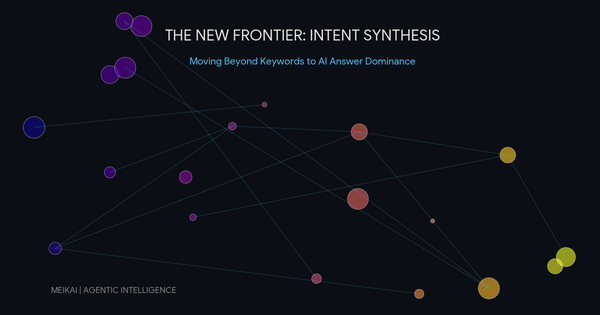
Not a dashboard that reports mentions after the fact, it is an always on system of specialized agents that observe → diagnose → recommend → validate changes across owned and earned channels, optimized for citation probability and faithful representation inside generative answers. - The paradigm shift: Modern discovery is moving from a "search" model (ranking links) to a "synthesis" model (influencing the generated answer).
- Multi agent workflow: Meikai employs a Multi Agent Content Optimization (MACO) framework, utilizing a producer critic loop to iteratively engineer content for maximum citation probability.
- Quantifiable influence: Success is measured through specialized AI native metrics: visibility (share of voice), mentions average, sentiment, and perception gaps.
- The bottom line: Traditional SEO gets you on the page; Meikai's ensures you are the preferred source chosen by the AI to answer the user.
1. The strategic reframe: from CTR to source influence
Traditional Search Engine Optimization (SEO) is becoming a secondary layer in a world dominated by Generative Search Engines (GSEs) like ChatGPT, Gemini, and Perplexity. Research indicates that GSEs synthesize conversational answers by summarizing information from multiple sources, which often bypasses the need for users to click on traditional "blue links".
In this new paradigm, visibility is no longer a ranking problem, it’s a control problem. The question isn’t “Did we get traffic?” but “What sources causally changed the model’s answer?”
That is what we call source influence: the measurable ability of a content piece to be retrieved, cited, and meaningfully shape the synthesized response (coverage, correctness, and framing) even when the user never clicks a link.
2. Advanced Workflow: Multi Agent Content Optimization (MACO)
Meikai's architecture is based on the MACO framework, a sophisticated multi agent system designed for autonomous iterative refinement of digital content.
The agentic visibility Loop (framework level view)
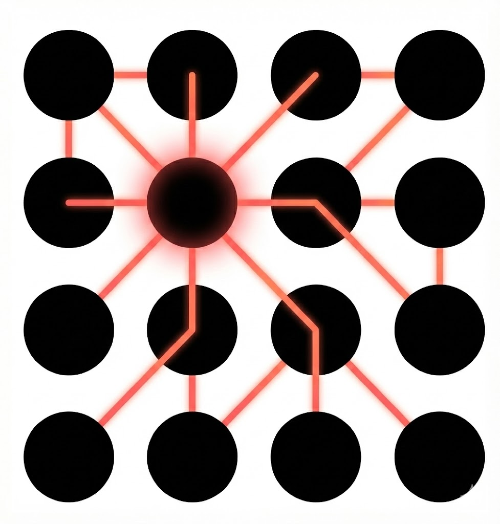
Meikai is agentic native because it runs as an always on loop each cycle produces a measurable hypothesis, a recommended action, and a validation step:
- Observe : Run controlled evaluations across generative engines (e.g., ChatGPT/Gemini/Perplexity) on real query clusters. Capture answers, citations, and framing.
- Diagnose : Decompose outcomes into perception gaps and source influence drivers (which domains/KIPs are actually moving the answer).
- Act : Generate prioritized, implementable changes across owned + earned channels (content edits, new pages, PR targets, KIP insertion).
- Verify : Re run the exact evaluation protocol to confirm lift (and detect regressions/drift).
This is why Meikai is a framework, not a report: it operationalizes LLM visibility as a repeatable optimization system.
OnSite agent: engineering content fidelity
The OnSite workflow utilizes a hierarchical multi agent structure to ensure your brand's owned media is optimized for AI retrieval.
- Gap logic: A specialized gap analyzer agent compares current brand content against real world user query clusters to identify "addressable knowledge gaps".
- The producer critic loop: A content producer agent creates structured recommendations, which are then evaluated by a critic agent. This "LLM driven feedback loop" ensures the content meets high standards for technical scannability and semantic density before being approved.
- Governance guardrails : The loop is constrained by brand “truth rules” (approved claims, prohibited claims, legal/compliance boundaries, and canonical sources). The critic agent rejects recommendations that increase citation probability at the cost of accuracy, policy risk, or inconsistent positioning because prompt gaming doesn’t scale.
OffSite agent: mapping and engineering authority
Visibility is heavily influenced by the perceived authority of the sources cited.
- Source influence benchmarking: The OffSite agent analyzes up to 500 earned media citations to identify which domains exert the most causal impact on the AI's final synthesized response.
- Citation triggers: By identifying the specific "Key Information Points" (KIPs) that consistently prompt an AI to cite a domain, the agent provides PR teams with a tactical roadmap for media outreach.
3. Measuring success: The 2026 outcome metrics
Success in the synthesis era requires moving beyond surface level attribution. Meikai captures the following outcome metrics to track a brand's true impact within the AI discoverability ecosystem:
| Metric | Business Value | Strategic Significance |
| Visibility (AI Share of Voice) | Entry Ticket | The percentage of responses that include your brand. |
| Mentions Average | Answer Dominance | Repeated mentions signal preferred authority and depth. |
| Sentiment | Narrative Alignment | Measures whether the AI's framing supports or distorts brand trust. |
| Perception Gaps | Market Perception Alignment | Reveals how the AI rates your brand versus competitors on key attributes. |
4. Conclusion: why this is fundamentally different
Meikai's approach represents a shift from search rankings to brand governance. Traditional SEO is a "static" optimization for a retrieval engine, whereas Meikai’s GEO is a dynamic optimization for a reasoning engine.
More precisely: Meikai is an agentic native LLM visibility framework. Instead of one off audits, it runs a continuous multi agent loop that (1) measures how engines speak about you, (2) attributes outcomes to the sources and KIPs driving the synthesis, (3) recommends changes across owned and earned media, and (4) validates improvement with the same evaluation protocol.
By utilizing the MACO loop and the CC GSEO Bench framework, we ensure that your brand is not just a "link" in a list, but a foundational source of truth used by the AI to form its worldview. In the AI era, the brands that dominate will be those that the engines choose to trust and repeat.
External Research References
- GEO: Generative Engine Optimization (Aggarwal et al., 2024)
- CC-GSEO-Bench: A Content-Centric Benchmark for Measuring Source Influence (Chen et al., 2025)
- Generative Engine Optimization: How to Dominate AI Search (2025)
- Multi-Agent Design: Optimizing Agents with Better Prompts and Topologies (Zhou et al., 2025)
- A Multi-AI Agent System for Autonomous Optimization via Iterative Refinement (REALM, 2025)
📌 FAQ: AI brand visibility
What is AI brand visibility?
AI brand visibility refers to how often and how accurately a brand is mentioned, recommended, or cited in answers generated by large language models (LLMs) such as ChatGPT, Gemini, Perplexity, or Grok. Unlike traditional SEO, AI brand visibility focuses on presence inside generated answers, not rankings or clicks.
How is AI brand visibility different from SEO?
Traditional SEO optimizes for rankings and traffic from search engines.
AI brand visibility optimizes for inclusion, framing, and authority inside AI generated responses, even when no link is shown. This discipline is often referred to as LSEO (Largemodel Search Optimization) or GEO (Generative Engine Optimization).
How do AI systems decide which brands to mention?
AI systems rely on a combination of:
- High authority public sources
- Consistent brand mentions across trusted websites
- Structured, machine readable content
- Clear topical authority signals
Brands that are consistently referenced by authoritative sources are more likely to be mentioned by AI models.
Can brands influence how AI systems talk about them?
Yes indirectly. Brands can improve AI visibility by:
- Publishing authoritative content
- Being cited by third party media
- Structuring content for AI retrieval
- Ensuring consistent brand positioning across the web
Direct manipulation or “prompt gaming” does not work long term.
How does Meikai help measure AI brand visibility?
Meikai monitors how brands appear across major AI engines, analyzes source influence, tracks competitors, and identifies which content and signals most affect AI responses. This allows marketing teams to measure, diagnose, and improve AI brand visibility over time.
What does “agentic native” mean in the context of AI visibility?
Agentic native means the product is designed as a system of agents that execute a closed loop workflow (observe → diagnose → act → verify) with explicit guardrails rather than a dashboard that reports mentions after the fact.