The agentic revolution: Why LLM visibility is the new frontier for retail growth

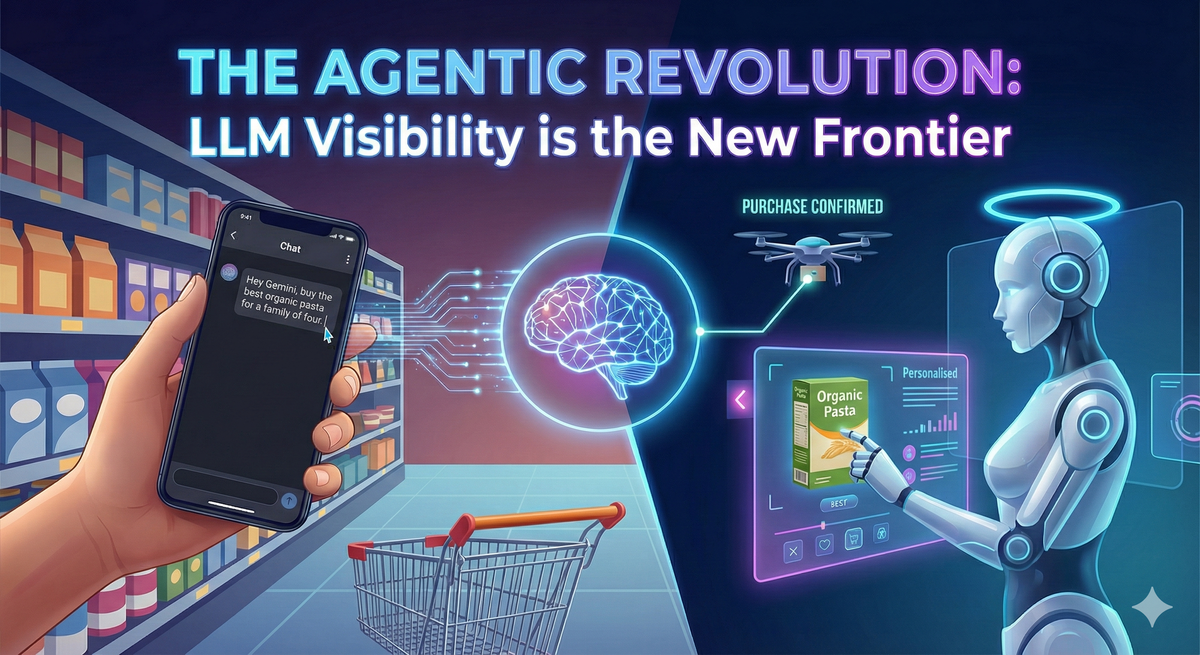
As we move into 2026, the primary interface between a brand and a consumer is shifting from the search bar to the personal shopping agent. According to recent data from Adobe’s Digital Economy Index , traffic from generative AI sources to retail sites has surged by over 1,100%, signaling a permanent shift in how consumers discover products.
At Meikai, we believe the next decade of retail won't be won by the brands with the biggest SEO budgets, but by those with the highest LLM visibility. When an AI agent is empowered to "buy the best organic pasta within a $50 grocery budget," being cited in the LLM’s response is the difference between a conversion and total invisibility.
1. The rise of agentic commerce
Consumers are increasingly treating LLMs as personal shopping tools. This shift toward autonomy is accelerating McKinsey projections for 2026 suggest that 'agentic commerce' will reclaim up to 40% of the time previously spent on manual research, as AI agents move from simple recommendations to executing end to end purchases.
In this "Zero Click" future, the shopper may never visit a retailer’s website. Instead, the LLM synthesizes vast amounts of data to make a "best fit" decision on the user's behalf.
- Contextual awareness: The LLM knows the user’s dietary restrictions, past purchase history, and current pantry levels.
- Autonomous execution: The LLM moves from "searching" to "buying," interacting directly with retailer APIs to fulfill an order.
2. Why "Citations" are the New Currency
For a retailer or CPG brand, appearing in an LLM's training set or real time context window is no longer optional it is a survival requirement. If the model doesn't 'know' your product’s specific attributes, it cannot recommend you. This is a critical blind spot, as Gartner predicts that by the end of 2026, 40% of enterprise applications will be powered by task specific AI agents. Brands that fail to provide machine readable, high fidelity data will essentially be invisible to this new $15 trillion economy.
The Visibility Hierarchy
| Tier | Status | Metric | Impact |
| Tier 1 | Direct Citation | Cited as the primary recommendation | High conversion; immediate purchase. |
| Tier 2 | Comparison Set | Included in a "Top 3" comparison | Moderate; relies on the agent's logic. |
| Tier 3 | Invisible | Brand not recognized by the model | Zero discovery; excluded from the agentic journey. |
3. Beyond SEO: Generative Engine Optimization (GEO)
Retailers need to extend traditional SEO practices into Generative Engine Optimization, moving beyond keyword optimisation toward richer, machine-legible data designed for LLM understanding and trust.
- Structured data excellence: Every product detail from dimensions to return policies must be formatted for AI ingestion.
- Semantic authority: Brands must build "topical authority" across the web so that LLMs associate their brand name with specific value propositions (e.g., "best for sensitive skin").
- Actionable API layers: Retailers must provide the "hands and eyes" for the LLM, allowing agents to check real time stock and price through unified platforms.
The reality check: By the end of 2026, it is estimated that over 30% of routine household purchases will be initiated or fully managed by AI agents. If your brand is not a "default" in the model's knowledge base, you are essentially off the shelf.
4. How LLM analytics platforms bridge the gap
Meikai acts as the intelligence layer that helps retailers navigate this shift. Instead of guessing how an LLM "sees" your brand, our platform provides LLM sentiment & citation Tracking.
We help retailers identify "blind spots" where the leading models (GPT-5, Gemini 2, etc.) lack sufficient data to recommend their products. By synthesizing supply chain data with LLM generated insights, we enable retailers to:
- Quantify "agentic reach": Track how often your SKUs are being selected by shopping bots.
- Optimize product narratives: Refine how product descriptions are written to ensure they match the "Intent Clusters" AI agents use for decision making.
- Audit semantic trust: Ensure that information about your brand is consistent across the web to prevent model "hallucinations" that could lead to lost sales.
FAQ: LLM Visibility for Retailers
Q: Why is being cited in an LLM more important than a traditional Google rank?
A: Because agents don't scroll through pages of results. They typically select the single "best" option or a very small subset. If you aren't in that top cited group, you don't exist to the agent.
Q: How do LLMs act as personal shopping tools?
A: They move from passive information retrieval to active goal fulfillment. Instead of you searching "healthy snacks," you tell the LLM, "Buy me healthy snacks for the week," and it handles the selection and checkout.
Q: Can a small retailer compete with giants in LLM visibility?
A: Yes. LLMs prioritize high fidelity, specific data. A niche retailer with a perfectly structured data layer and high semantic authority in a specific category can often outrank a "generalist" giant.